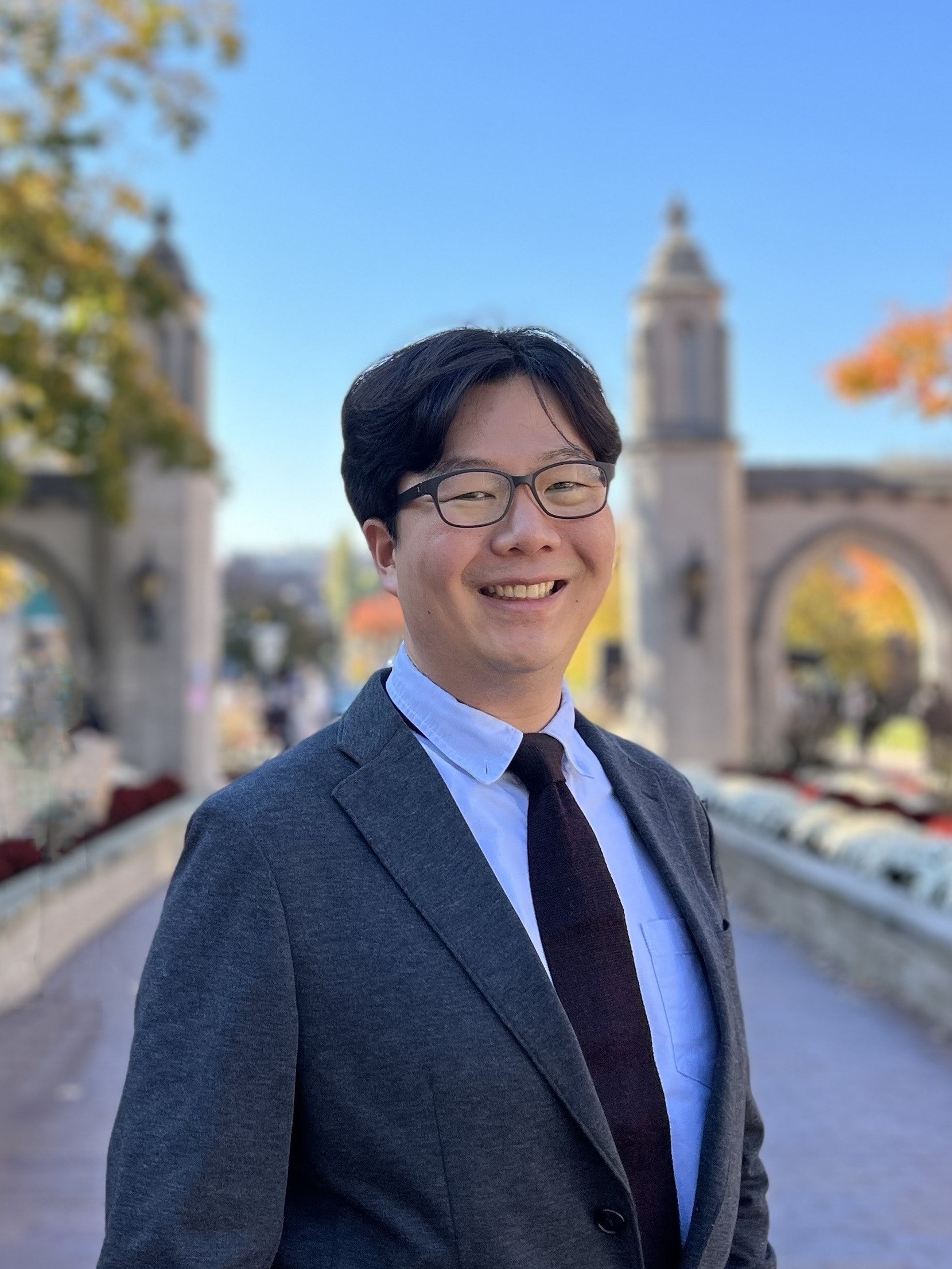
Economist
Macroeconomic Modeling Team
Office of Economic Modeling and Policy Analysis
Bank of Korea
Email
kangseokil (at) bok (dot) or (dot) kr
Mobile
+2-10-8968-oo27
Address
67, Sejong-daero, Jung-gu, Seoul, Korea
I am an Economist at the Bank of Korea. I received my Ph.D. in Economics from the Indiana University Bloomington in 2022.
Field of Interest: Macroeconomics, Monetary and fiscal policy, Bayesian Econometrics
Disclaimer: This site does not express the views of the Bank of Korea.
Working Papers
Quantifying the Fiscal Backing for Monetary Policy, Paper(pdf), Codes
| Abstract |
| I ask to what extent can data reveal whether fiscal policy responses to monetary policy shock are consistent with the theoretical adjustments necessary for successful inflation-targeting monetary policy. I employ a DSGE model to estimate the fiscal response to a monetary policy shock under the active monetary and passive fiscal policy regime. A monetary contraction raising interest rate by 25 basis points reduces the market value of government debt by 0.8% because the bond price devaluation outweighs the fall in inflation. This reduction splits into a 1.7% decline due to higher discount rates and a 0.9% increase in expected primary surpluses. I also estimate a VAR that takes an agnostic view on the policy regime to examine how closely the data conforms to the theory. I find that the data accounts for 90% of the primary surplus response dictated by theory, suggesting that the data reveals the presence of fiscal backing for monetary policy. |
Simulated Annealing Multiplicative Weights Algorithm for Solving a DSGE Model, Paper(pdf), Codes
| Abstract |
| This paper introduces a simulation-based adaptive algorithm to solve a DSGE model with a large state space, namely the curse of dimensionality. It aims to generate a stationary distribution over policy space which is concentrated on the optimal policy. The key strategy is to construct a finite policy space of heuristic policies. To update the distribution over policy space, the method adopts on-line computation via iterative simulation with emphasis on rolling-horizon control to foster the speed of algorithm. Subsequently, I deliver that the algorithm achieves theoretical convergence to the optimal value function and the stationary distribution over policy space is concentrated on the optimal policy. Application to solve the simple two-period RBC model follows as a sample exercise. The result shows the performance is desirable within the feasible number of iterations and size of restricted policy space respectively. |
Policy Work
BOK-LOOK: A Semi-Structural Model for Korea’s Open Economy and Monetary Policy Analysis, Paper
| Abstract |
| This paper introduces BOK-LOOK, a large-scale, semi-structural model developed by the Bank of Korea to support its forecasting and policy analysis. Inspired by the FRB/US model, it is estimated using a fully Bayesian method to ensure robust parameter estimation and empirical consistency. The model employs a VAR-based expectations framework and polynomial adjustment cost specifications to balance theoretical coherence with empirical adaptability. The model features a detailed external sector by the inclusion of a high-resolution foreign blocks and financial synchronization channels that captures the impact of the global business and financial cycle to Korean economy. Consequently, BOK-LOOK is tailored to generate internally consistent projections for key macro variables and supports various scenario analyses. Another distinctive feature is its comprehensive treatment of financial stability concerns through the explicit incorporation of household debt and housing prices dynamics, reflecting Korea’s unique economic and financial characteristics. By providing both economic forecast and counterfactual analysis capabilities, the model establishes a coherent framework for understanding macroeconomic dynamics and informing monetary policy decisions. |
with Seungryul Jeong, Hyungbae Cho, Jinwoon Yoon, Dongjae Lee, BOK Working Paper Series
♦ Click course title to see syllabus
Teaching
Miscellaneous
Julia Replication for Arellano(AER 2008)